

“To seek the timeless way we must first know the quality without a name. There is a central quality which is the root criterion of life and spirit in a man, a town, a building, or a wilderness. This quality is objective and precise, but it cannot be named.”
Christopher Alexander
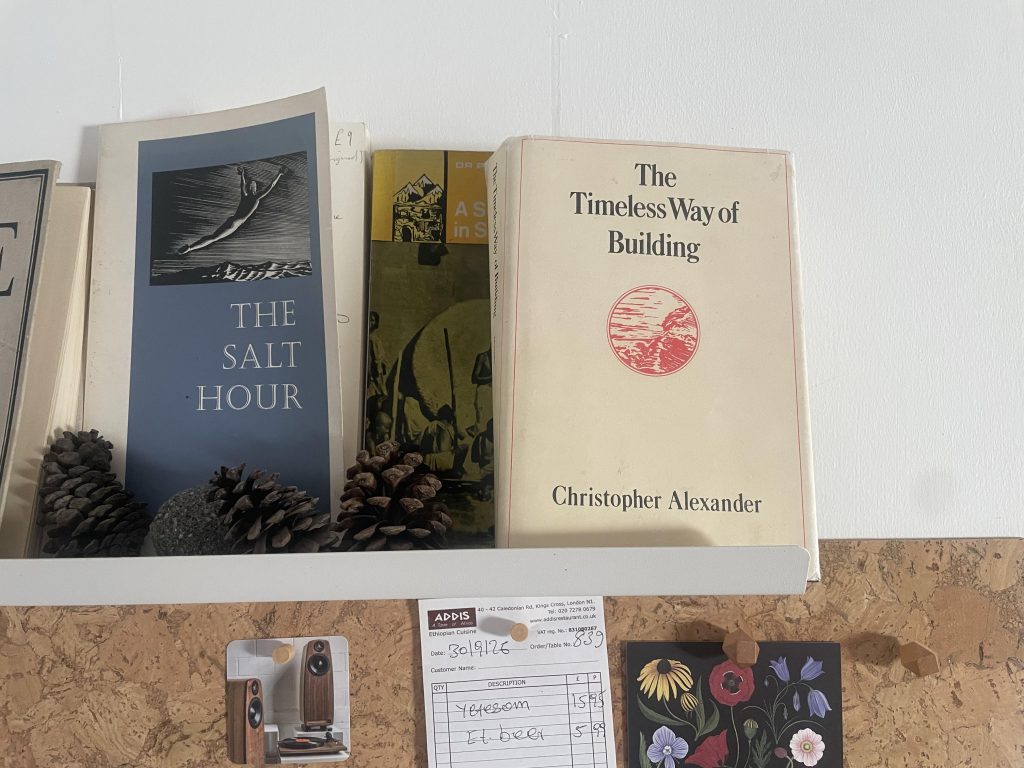
There is a quality Alexander called the quality without a name, the feeling that a place is alive and could not have been otherwise. It shows up in kitchens that have been cooked in for fifty years. It shows up just as clearly in rooms where records are actually played.
PATTERNS FOR LISTENING ROOMS
1. A ROOM FOR REFLECTION
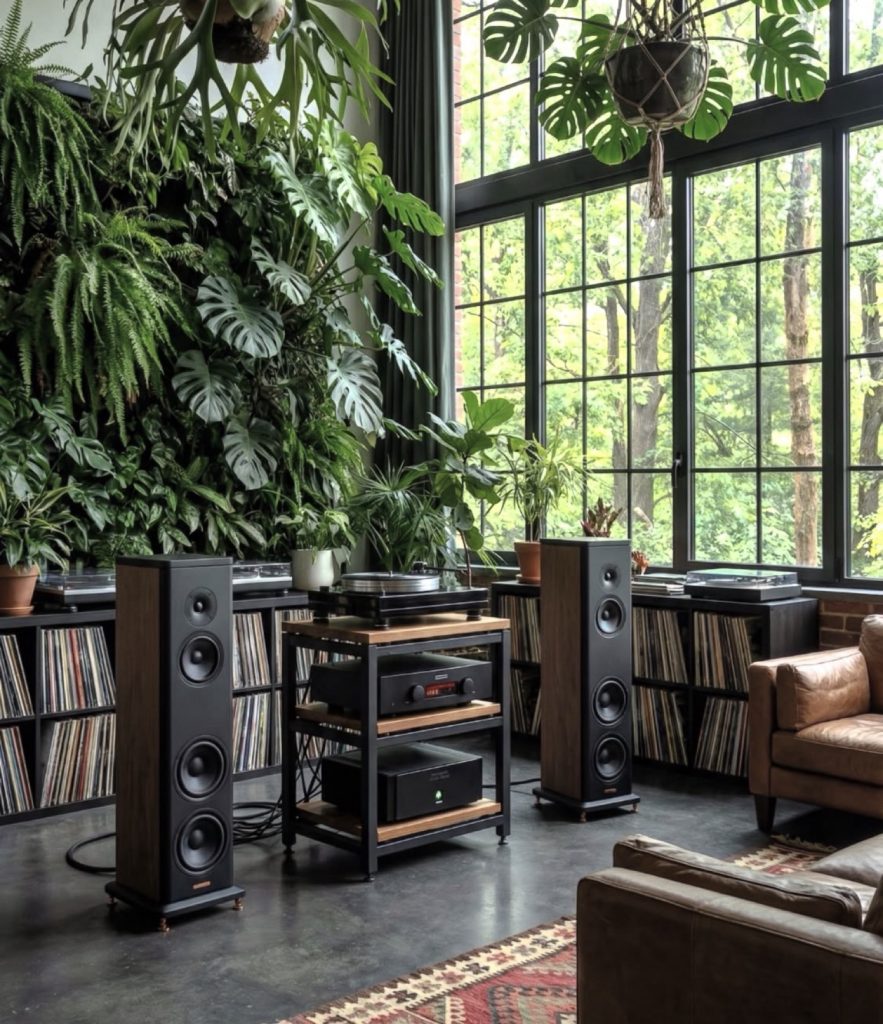
A sealed box turns the listener into a technician. Give the room a living world beyond the glass — trees, water, weather — or, in the archive, a wall of recorded time.
2. THE TWO SENTINELS
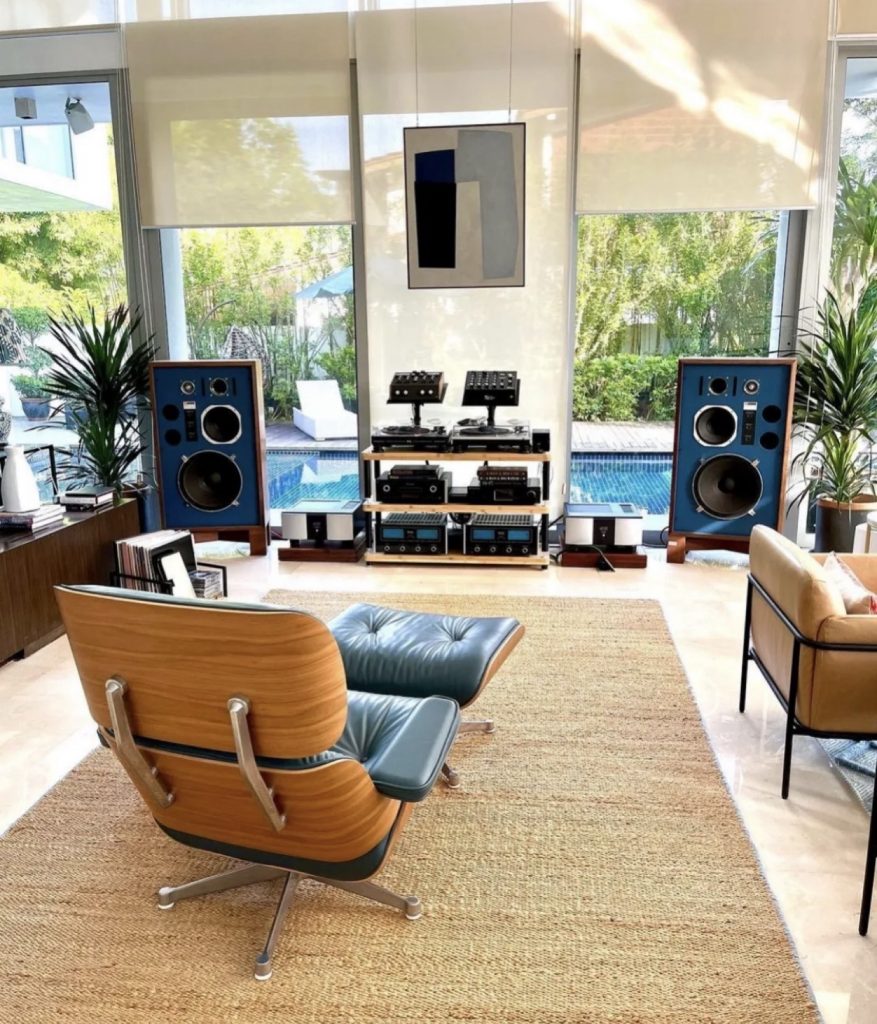
Hidden speakers make a cinema. Stand two loudspeakers in the room as independent figures: walnut towers, blue horns on plinths, mixed cabinets, violin-shaped wood. They need a shadow and a floor.
3. THE ALTAR BETWEEN THEM
The source of the captivating music. A turntable on a dedicated rack, stand, or sideboard between the speakers — low enough not to block the stage, high enough to drop a needle without kneeling.
4. THE CHAIR THAT FACES MUSIC
Seats aimed at a screen train the body to wait for a picture. One honest chair (or a sofa used as one) sits on the center line. The Eames lounge is the pattern in pure form; the leather couches and the grey sofa do the same work.
5. WALLS OF MEMORY
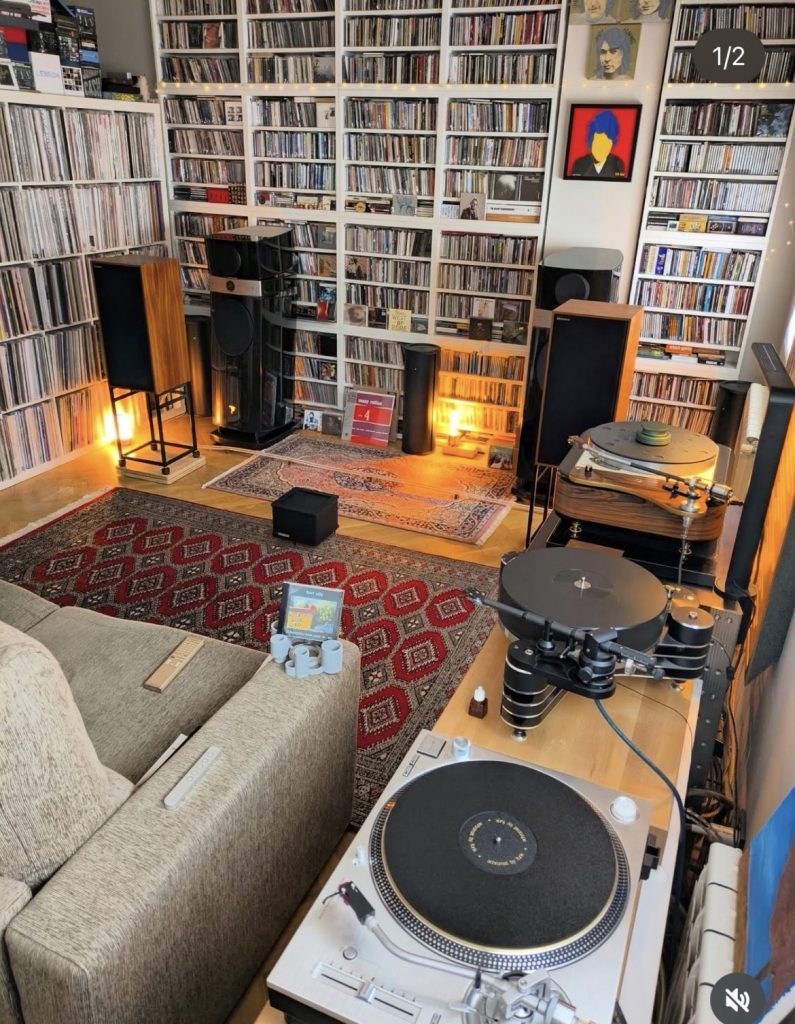
A collection in another room starves this one. Let spines become architecture. The cave is the extreme; the conservatory runs record cubes under the plants; even the villa keeps a crate within reach. Irregular shelves full of uneven objects are better than most panels you can buy.
6. A RUG THAT GATHERS THE PLACE
A hard floor from wall to wall is a corridor. Every room throws a textile island onto concrete, marble, or wood: kilim, jute, layered Persians. The rug is the room inside the room.
7. GREEN THAT LISTENS AND VIBRATES
A dry room of wood and glass photographs well and feels uninhabited. Plants are volume, not garnish — a fern wall, trees flanking the horns, a whole backyard as the rear wall. They scatter sound. They also breathe.
8. THE VISIBLE NEEDLE
A tap on a phone leaks attention. Keep playback slightly inconvenient: a spinning platter, a jacket standing up, two or three decks if that’s how you live. The inconvenience is the beginning of the room.
9. DISCREET LIGHT FROM THE SIDE
Overhead office light kills evening. Lamps, strings, floor glow, blinds against glare. A listening room should be able to go almost dark and still be kind.
10. CLEAR AIR BETWEEN
Life creeps into the triangle and the stage collapses. Keep a generous empty field between the sentinels and the chair. Everything else crowds the edges. The equilateral triangle is not a fetish. It is a clearing.
11. NATURAL MATERIALS
Surfaces that cannot take a mark will look dated next year and they ring. Wood, leather, wool, paper spines, brick, leaves. The room should look better in ten years.
12. A ROOM APART
An open-plan corner is always interrupted — and always interrupting. Make a precinct: a door, a rug that declares a boundary, a glass nave, a porch that became a chapel. Entering it must be a change of state.